Traditional archery FAQ
This article is about archery with traditional equipment, in particular the English longbow. I concentrate on the longbow primarily because that's what I know about. Please note: for reasons of historical completeness this article discusses hunting with a bow. This activity is illegal in the UK, and I absolutely don't condone it. In any case, I'm a vegan, so I wouldn't condone it even if it were legal. Which it isn't.
Q. What is traditional archery?
A. Traditional archery is the sport/martial art of archery carried out with equipment made using materials and methods which were in use before (essentially) the industrial revolution. Traditional archery is much more a martial art than modern archery, in the sense that much greater mental and physical discipline is required to achieve the same result. In addition, the equipment used is more like that which would have been used when bows were used for military purposes.
The term `traditional' does not have a precise definition, and many clubs that practice traditional archery accept modern bows and arrows, provided they are shot in `traditional ways' (that is, barebow -- without mechanical release aids and optical sights). Even the most authentic traditional bows are now usually made using some modern materials -- most bowyers will not make glue by boiling up horse sinew, for example. So, clearly, traditionalism is a matter of degree, rather than kind. For some people, any kind of barebow shooting constitutes traditional archery. For example, Byron Fergusson -- a noted exponent of barebow shooting -- refers to himself as a traditionalist, but uses aluminium arrows. Other people strive to practice archery as close to the way it would have been done in medieval times as possible.
Traditional archery enthusiasts usually shoot longbows, flatbows, one-piece wooden recurve bows (usually called `hunting bows' in the UK) or, very occasionally, bows based on the traditional weapons of Eastern Europe or the Far East.
As in any other form of archery, to practice traditional archery you will need a bow, some arrows, rudimentary protective equipment, somewhere to shoot, and something to shoot at.
Q. What are traditional bows made of?
A. Mostly wood (or, occasionally bamboo -- is that a type of wood, or something else? Answers on a postcard...), with other materials for the finishing touches -- leather, hide, horn, bone, feathers, etc.
Q. What is the difference between a longbow and a flatbow?
A. These terms are often used interchangeably to mean a long, relatively thin, straight bow. However, technically there is a difference, at least in the UK. A longbow has a D-shaped cross-section throughout, while a flatbow has a rectangular cross section to its limbs. Longbows were favoured in England between the 13th and 16th centuries, not because of any inherent technical advantages over flatbows, but because they were economical of wood and therefore cheaper to make in large quantities. A flatbow had to be cut from a wider stave, and carved down to hand width at the handle -- not ideal when bows had to be made by the thousand for military use. Longbows were called longbows because the very high compressive forces that were generated in the narrow part of the `D' meant that they had to be long to stand a reasonable draw length. Flatbows had a better spread of compressive force across the width of the bow, and could be shorter for the same draw.
A bow referred to as an `American longbow' is probably a flatbow, not a longbow at all, as the term is understood in the UK.


Q. What is a recurve bow?
A. A recurve bow has limbs which point forwards when the bow is unstrung. When it is strung, the limbs are drawn back by the string, and typically end up pointing straight up and down. Recurve bows were uncommon in Europe until quite recently, but their superior energy storage properties make them better than straight bows in many respects. Most modern bows are either of recurve pattern, or mechanically-assisted (compound).
Q. What are mongol, scythian, and magyar bows?
A. These bows are short, recurve bows with a much larger bracing height (the distance between the string and the arrow rest) than western European bows. They are available in the UK from specialist manufacturers, but are not commonly used at present.
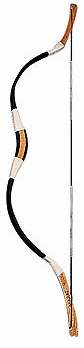
Q. What is a hunting bow?
A. This is a vague term for any traditional bow with a heavy draw (usually 50 lbs or more) which is based on a pattern which was common after the days of military archery. In the UK, the term is usually used to refer to a recurve bow with a carved handle, sight window, and arrow shelf (see below), patterned after a design that was common in the Victorian era. These bows are now often made with modern materials (perhaps including glassfibre or carbon fibre), and shoot more like a modern Olympic recurve than a longbow. However, practiotioners usually shoot them without sights, so they probably still qualify as `traditional'.
Q. What type of bow is most popular in the UK?
A. Most traditional archery enthusiasts in the UK shoot a longbow, probably because of its historical connection with Robin Hood, the battle of Agincourt, etc. Of all the bows that might reasonably be considered `traditional', the longbow is the hardest to shoot, the least accurate, and has the shortest service life.
Q. What makes a longbow `authentic'?
A. An authentic longbow is a stick with a string -- not like the ornamental versions that many bowyers now offer for sale. The bows that you can see in the Lord of the Rings movies are not longbows. Longbows were designed to be disposable, and never lasted long enough to become family heirlooms. The handle will be wrapped with leather or cloth and, because a longbow was designed to be shot `off the knuckle', there will be no arrow rest or shelf (see below).
In England, longbows were usually made of ash, because it is easy to work and grows prolifically. However, most modern bowyers -- in England and elsewhere -- prefer to work with yew, lemonwood, osage orange (`hedge apple') and purpleheart. Of these, only yew is a native species in the UK, and even that is not particularly suitable for bowmaking. Medieval Egnlish bowyers frequently imported yew wood from Spain. Purpleheart is a tropical wood, and is unlikely to have been used in a mediaeval longbow. Bowstrings would probably have been made from linen and/or hemp.
In the modern world, of course, longbows are not made in quantity and are therefore extremely expensive to produce. Consequently, all but the most dogmatic traditionalists accept that it is better to sacrifice a measure of authenticity for a longer service life. In particular, few archers now use linen strings because they break so easily.
Q. What is `backing'?
A. The `back' of a traditional bow (well, any bow really, but in modern bows it is not particularly important) is that part that faces away from the archer, and it subject to tension forces during draw. The back is a critical part of a traditional bow -- it is subject to extreme stresses, and any weakness here will eventually lead to a catastrophic failure. `Backing' a bow means fastening a thin strip of material onto the back edge, either to increase the bow's tolerance of tension forces, or to protect the back wood from impact damage (e.g., being dropped), or both. In a `self-backed' bow, the backing is made from a different part of the same wood (this subject -- construction of self-backed bows -- is discussed in more detail below). In a `composite' bow, the back is made from a different wood. In some parts of the world, bows were backed with hide or sinew.
Q. What is a `composite' bow?
A. A bow made from laminations of different types of wood. Using this manufacturing technique allows a balance between the different properties of the different woods and, hopefully, a longer service life and better cast (arrow-throwing ability). When a laminated bow is drawn, energy is stored as shear forces in the glue, as well as in tension forces in the wood. Because the glue is more elastic than wood, storing energy this way is more efficient and less destructive. The more laminations that are used, the greater the gain in efficiency and durability. Good quality longbows tend to have three laminations -- a `back', a `centre', and a `belly'.
Q. What is a `carriage bow'?
This is the quaint name, of uncertain origin, for a bow that can be broken down into to parts -- presumably for carriage. The two parts were typically joined, when the bow was in use, by a steel tube about a foot long. As well as being more convenient for the shooter, many bowyers consider carriage self-bows easier to construct than one-piece self-bows, despite the increased mechanical complexity. The reason for this is that it allows the bowyer to use two shorter staves of wood instead of one full-length piece, and is easier to find two short pieces of straight-grained wood than one long one.
Q. What does `self-nocked' mean?
A. If a bow or an arrow is self-nocked, it means that the nock is cut into the wood itself, rather than being made of a different material. Self-nocking is cheap, and was commonly used for arrows because they were disposable. Self-nocking is not ideal for bows, because it might not give sufficient strength to stand the shear forces of the string. Bow nocks were, and generally still are, made of carved animal horn. Arrow nocks would have been protected by a winding of thread around the nock area to prevent the shaft splitting. Modern traditional arrows tend to use plastic nocks, because the service lifespan of self-nocked arrows is not particularly good, and we no longer regard arrows as disposable.
Q. What are traditional arrows made from?
A. Shafts are usually of wood (perhaps bamboo), with feather fletchings and points of steel or brass. In modern practice, the arrowheads are usually glued to the shaft, although in earlier days they would have been tied.
A longbow will shoot modern metal, glassfibre or carbon arrows perfectly well, so long as they are spined to suit the draw weight and have flexible vanes (particularly important for shooting off the knuckle).
Q. What arrow points are used?
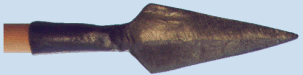
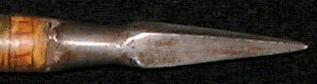
A. In most parts of the world, the earliest arrows for military and hunting use had broadhead points (that is, shaped like a short, flat, knife blade), made from stone, copper, or iron. Broadheads have a cutting action, and are very effective against flesh. However, they are of no use against armour or chain mail, because the impact force is spread over too wide an area. Consequently, in Europe during the 15th century, attention focused on short, thin, points. A particular example was the `bodkin' point used by the English forces at Agincourt. This was a needle-like point an inch or two in length. By concentrating the impact force over a small area, the bodkin had great penetrative power, and was effective against armour. It was also effective against chain mail, because the point was thin enough to slip through or between the rings of the mail.
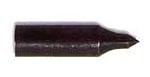
For field archery, modern practitioners tend to favour steel field points, which are essentially a truncated bodkin. These look quite authentic and, unlike broadheads, do not tear the target to shreds. For target archery, brass piles seem to be more common.

Q. What is a sight window?
A. This is a cutout in the bow riser (handle) which allows the arrow to shoot `through' -- rather than around -- the riser. Having a sight window reduces `archer's paradox' (see below), and all modern bows have sight windows. Some traditional bows also are made with a sight window, but it is relatively unusual because the cutout significantly reduces the strength of the handle.
Q. What is an arrow shelf?
A. A piece of wood, horn, hair, or bone that the arrow rests on when the bow is drawn. If the bow has a sight window, then it also has a shelf -- the bottom of the cutout. However, even in this case it is common to line the shelf with hair. Longbows and flatbows can be made with an arrow shelf, or have one fitted, but this would have been historically unusual. Such bows would normally have been shot `off the knuckle'.
Q. What is shooting `off the knuckle'?
A. On a bow with neither a sight window nor an arrow shelf, the arrow rests on the knuckle of the archer's index finger. As the arrow is released, the feathers of the bottom fletching compress as they pass over the knuckle.
With good quality arrows, shooting off the knuckle is merely uncomfortable, rather than catastrophic. The feathers abrade the skin of the finger and, eventually, leave an inflamed weal that (if you're lucky) callouses over. However, if the feathers tend to come adrift from the arrow shaft, then eventually one will get embedded in your finger, and no callous will prevent that being a memorable experience. The effect of splinters in the arrow shaft hardly bear thinking about. Most traditional archers, particularly the ladies, wear gloves.
Q. What is an arrow pass?
A. A piece of hard material (bone, metal, mother-of-pearl) set into the side of the riser where the arrow would otherwise wear away the wood as it flies off the bow.
Q. What does it mean to `come round compass'?
A. A bow that `comes round compass' forms a perfect arc of a circle when it is drawn. By definition, a bow that comes round compass has even tiller -- the distances from the string to the bow limbs are equal when measured above and below the bow centre. It isn't necessarily the case that a traditional bow should come round compass, or have even tiller, but it is very common for them to be made this way.
Q. What protective equipment is used in traditional archery?
A. There is evidence that at least some mediaeval European archers wore leather gloves to protect their fingers from the effect of drawing the bowstring, and from arrow abrasion, and a forearm bracer to protect their forearms from the string impact. However, this was not always the case. Most practioners now wear at least a glove or finger tab on the bowstring hand, and a bracer.
Q. What sort of quiver is authentic?
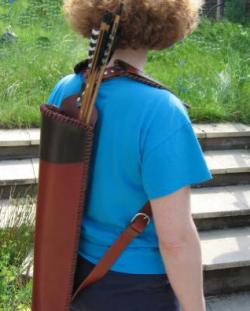
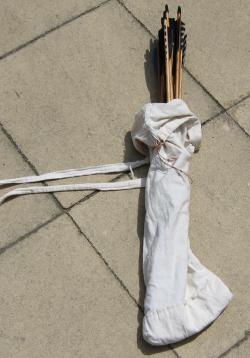
A. In the UK, the quiver -- in the sense of a leather arrow tube -- is a relatively recent innovation. It was uncommon before the Victorian era. During this era, when the bow was used for sport and hunting, leather hip quivers were quite common. In the medieval era, military archers typically carried their arrows in a canvas bag, which they tied around the waist or back. The bag could usually be tied at the top to protect the fletchings. During the battle, it seems that it was common to stick your arrows in the ground by your feet, rather than keep them in a bag/quiver. This had the dual effect of making the arrows easily accessible, and of making the points muddy. While a glancing blow with a muddy arrow point might not eliminate an enemy from the field of battle straight away, in the days before antibiotics it would likely have kept him out of the next battle.
I believe that the concept of the `back quiver' comes from Errol Flynn's Robin Hood movie. There doesn't seem to be much evidence that back quivers were ever used for hunting or warfare. In fact, it would have been virtually impossible for Robin Hood to hunt deer in Sherwood Forrest using a back quiver: deer are easily alarmed, and would run a mile at the sight of a quiverfull of arrows waving about at head height. Many field archers, however, favour back quivers for their convenience.
Q. What is `archer's paradox'
A. An arrow, when released from a bow, will not fly in the direction it was pointing at full draw, even if released perfectly -- the handle gets in the way. The `paradox', strictly speaking, is not this deviation of the arrow from the centreline of the shot, but the observation that the effect is, in fact, not as pronounced as the geometry of the bow would appear to make it. Nevertheless, the term `archer's paradox' is widely used to mean the phenomenon of deviation of the arrow from the centreline.
Archer's paradox -- in the sense of deviation from the centreline -- affects all bows with the exception of modern compound bows shot with a mechanical release aid. In all other cases, the lateral forces exerted on the nock of the arrow when it is loosed will cause the arrow to deviate from its original direction of aim.
Paradox is particularly bad on longbows, because the arrow rests on the side of the riser, about a half inch from the centre of the bow. This means that, as the arrow is released, the nock is pulled sharply to the right (if you're shooting right-handed), and the arrow point deviates to the left of the centreline. Even on bows with a sight window -- in which the arrow rests on the centreline of the bow -- `paradox' is caused by the lateral movement of the fingers when the arrow is released.
With a traditional longbow, if you shot a perfectly rigid arrow, bow geometry would create a lateral error of about 10 degrees to the left; this means that if you shoot over a distance of 20 yards, you could expect the arrow to land left of the aiming point by about ten feet! In practice, the amount of lateral error will depend on the spine (flexibility) of the arrow, because at the instant of release the arrow will flex outwards to clear the riser, then straighten up (more about spine later). So, in practice, the leftwards error is not as great as 10 degrees; with a good choice of arrows it will be 1-2 degrees. This error is still significant, and many longbow archers overcome it to a certain extent by canting (leaning) the bow at an angle of 20-45 degrees to the vertical (see below). In addition, the lateral error introduced by the fingers on release will, to a certain extent, counteract the effect of the centering of the nock, as will the slightly deflection of the arrow by the feathers as they pass over the riser.
Q. Should you cant (tilt) the longbow/flatbow to shoot it?
A. This is a tricky one. There are two good reasons and one bad reason for canting the bow. The good reasons are that it helps to stop the arrow falling off the knuckle or shelf, and that it compensates in part for `archer's paradox' (see above). The bad reason is that it can shorten the draw, which is helpful if you can't handle the full weight of a heavy bow (buy a lighter one!)
Canting the bow seems to be typical in North America, but much less common in the UK. Most target longbow archers in the UK keep the bow absolutely vertical. In most movies that feature archery, bows seem to be canted to the upper end of the workable range -- 45 degrees or so. This does undoubtedly look more dramatic, but it puts considerable stress on the neck and shoulder muscles with a heavy bow. Field shooters seem to cant their bows slightly.
As far as `archer's paradox' is concerned, canting merely transforms a lateral error to a vertical error; but, it is argued, longbows archers have to accomodate for significant vertical errors anyway, as the arrow flight is not particularly fast. In that case, if lateral error can be reduced, the archer has to worry only about vertical errors. The problem with this reasoning is that canting introduces a new variable -- the angle of the bow -- in place of the effect of vertical errors. Nevertheless, if you can find, and maintain, an optimal angle of cant, then it should hold good regardless of distance. If you hold the bow upright and mentally compensate for lateral errors, you will have to adjust by a different amount at different distances.
With my longbow and arrows, with the bow canted to about 20 degrees, the lateral error is about one degree to the left (I measured this by shooting over a clout distance -- 180 yards). At sixty feet this still means I have to aim to the right of the mark by a few inches. However, if I cant more than this, I can't keep the angle consistent from shot to shot. At sixty yards, I have to aim right of the mark by several feet.
If you do decide to cant the bow, most likely you will have to cant also your head or your body, to get a consistent anchor point (see below).
Q. What is spine?
A. Spine is a measure of the arrow's flexibility. Spine is frequently measured in pounds, but is not necessarily the same as a the draw weight of the bow. Usually spine is defined as the amount of weight which would have to be applied to the centre of a 26-inch length of arrow material to make it deviate by a half inch. This amount of spine is reckoned to be a good match to the draw weight of a modern recurve bow. That is, if you have a recurve with a 36 lb draw, you need arrows with a 36 lb spine, if your draw length is 26 inches. If your draw length is longer, then you need an arrow spine which is stiffer by the same proportion.
Most authorities recommend that a traditional bow -- one in which the arrow shaft has to fly around the riser, rather than through it -- needs an arrow spined at about 66%-75% the value that would apply to a recurve bow. So if your longbow draw weight is 50 lbs, and your drawn length 26 inches, then you need an arrow spined for about 35-40 lbs.
Q. What draw weights do traditional bows have?
A. It appears that most traditional archery, except for longbow and Kyudo, used draw weights of 40-60 lbs. Surviving native American bows have draws of 55-60 lbs -- the upper end of the range. But these bows were comparatively short, so they needed a heavy draw to compensate for the short power stroke. Kyudo bows tend to have relatively low draw weights, but a very long power strong -- the draw might be to the ear or even behind the head.
Some mediaeval military longbows probably had draw weights over a hundred pounds. Heavy draws were necessary to counteract for the inherent inefficiency of the longbow design, and the fact that an extremely heavy arrow was used. However, there is some uncertainty about this, because no bows from this era have survived in shootable condition. If we assume that the mediaeval bowyers knew about arrow spine (see above), from measurements made on the surviving arrows we can determine that the corresponding bows had draws of 110-180 pounds. The bows recovered from the wreck of the Mary Rose were of dimensions that suggested draws of up to 160 pounds. However, we can't be certain that medieval arrows were spined in the same way as is common today, and there is evidence that everything on the Mary Rose was oversized. Taking these factors into account, and considering the distances used for archery training as defined in various mediaeval documents (~200 yards), suggests that draws of 70-80 pounds were more usual. But, as I said, there is no general agreement on this.
For hunting, draw weights of 35-50 pounds were, and are, most effective. You'll only need the upper end of that range if your bow is very short. Victorian-style `hunting bows' tend to have overall lengths 50-60 inches, rather than the 70 inches or more that is common for longbows. Consequently, these bows would normally have had draw weights of 45-50 pounds.
It is important to bear in mind that different draw weight and draw length considerations apply to the different intended uses of a bow. When a bow was used against a horseman, the most important consideration was that the arrow could unseat the horseman from his horse. The arrow did not necessarily have to penetrate armour or even flesh. This meant that the arrow had to be heavy, so the impact would knock the horseman down even if the arrow did not penetrate. Consequently, for this application, draw weights had to be very high to propel a heavy arrow a respectable distance. Accuracy was never a significant consideration for military archery, as the prevailing tactic as to unleash a storm of arrows in the general direction of the enemy.
For hunting, however, accuracy was much more important than arrow momentum. At the kinds of distances where you stand any chance of hitting anything, a 35-lb bow will fire an arrow that will penetrate the ribcage of most animals. It's important to realize that the ability to penetrate a ribcage depends primarily on the speed at which the arrow is travelling at impact. Contrary to popular opinion, a heavy bow won't necessarily cast an arrow faster than a light one, because a heavy bow requires heavier arrows. What's more, you could probably hold a 35-lb bow at full draw long enough to aim -- something that is virtually impossible with a very heavy bow.
While there is a certain macho appeal in being able to draw a heavy bow, there is no realistic application of archery in the modern world that requires a draw of more than about 50 pounds. What's more, unless you practice every day, drawing even 50 pounds could easily lead to injury.
Q. What is the effective range of a longbow?
A. It depends what you mean by `effective'. I believe that the longest flight distance that has ever been recorded for a traditional English longbow is about 300 yards. In practice, most top quality longbows will shoot about 180 yards easily enough (which, not coincidentally, is the standard distance for `clout' archery). In medieval times, archers regularly trained at distances over 200 yards.
Whether you could hit any kind of target at that distance is a different matter. The first problem is that you're going to be aiming the bow above your head, so you've got absolutely nothing to use as a sighting reference. Then you have to deal with the effect of `Archer's paradox', which is substantial at such a distance. Finally, the relatively slow speed of longbow arrows makes them very prone to wind deflection. I think that, in general, the greatest distance at which you could use a longbow for hunting (even if it were legal in the UK, which it isn't) would be about 20 yards, and even that would take considerable practice. For military use, well... you could probably hit a man-sized target somewhere at 60 yards or more, but I don't think that longbows were ever used that way; more commonly they were used as the `machine guns' of warfare, to generate a scatter of arrows in the general direction of the enemy.
Q. What is a blunt?
A. A rubber ball placed over the end of the arrow, either for safety purposes (in, for example, battle re-enactments), or for hunting small game. Shooting small game with a pointed arrow is a waste of time, because the arrow will just pass straight through, and the unfortunate animal will hop away and die where you can't find it. A blunt will at least stun the animal long enough for you to catch it.
Q. What is a flu-flu?
A. A tuft of feathers placed just in front of the fletchings, to slow the arrow down (for the same reasons as using a blunt).
Q. What is two-way shooting?
A. Traditional archery training was `two way'. That is, there were target bosses at both ends of the training field. After shooting all their arrows, the archers would walk to the targets, retrieve their arrows, and shoot at the target boss where they started from. And so on. Since they were shooting relatively long distances, this method minimized the amount of time spent walking up and down.
Q. What is the correct draw technique for a traditional bow?
A. Most traditional archers in the UK use the `Moroccan' draw, with two fingers below the arrow nock and one above. In certain tournaments this draw is compulsory. In North America, it seems more common to draw with three fingers below the arrow. Potentially this draw allows the arrow nock to rest closer to the eye, which should allow for easier aiming. Mongol/Magyar bows were traditionally drawn with the thumb.
With traditional archery, as in any form of archery, it is vital to draw the arrow back to a consistent place. Most traditional archers draw so that one of their finger tips touches the corner of the mouth. There is some evidence that the most `authentic' draw for an English longbow is to the ear, but average arm lengths are probably three inches or more longer now than in the mediaeval period, and if you're over six feet tall it's unlikely that you'll be able to find a longbow which will tolerate such a draw. I believe that only Japanese traditional archery still favours drawing to the ear; this may be because kyudo bows have comparatively low draw weights -- usually 30 pounds or less.
A related question is whether you should keep you head upright when you draw, or lean it over. If you cant the bow (see above) You will almost certainly have to lean your head at least a little, otherwise you won't be able to get you fingers back to your face without fouling the bowstring. Leaning your head allows you to get your eye directly over the arrow shaft, which many people find improves their lateral accuracy. However, since it is very difficult to learn a consistent angle of lean that can be made constant from shot to shot, you may pay for your improved lateral accuracy with a less consistent draw length (and, consequently, poorer vertical accuracy).
Q. What kinds of sights are used on traditional bows?
A. Although purists eschew any kind of sighting altogether, my gut feeling is that, in the days when a person's life would have depended on how accurately he could shoot, an archer would have made use of whatever sighting aids were available, if it were necessary. A `sight' may be as simple as a set of marks scratched into the bow riser to aid with elevation adjustment. Alternatively, with a longbow or flatbow you could tie a thin leather lace around the upper limb and slide it up or down to adjust. Many longbow shooters use a rubber O-ring (such as a tap washer).
The problem with these sighting aids is that they are useful all if you know the distance to the target. For target archery, of course, you will know the distance. For field archery you probably won't. Consequently, most field archers favour shooting without sights of any kind.
Q. What is instinctive shooting?
A. Instinctive shooting is shooting without conscious adjustment for range. The logic seems to be that if you shoot enough arrows, you'll eventually learn what the target picture looks like at each range, so you don't have to think about it. The relationship between `instinctive' and `gap' shooting (see below) is a contentious one. There are those that contend that there is no such thing as instinctive archery at all, and that those who claim to shoot that way are really using some variant of `gap shooting' at a less conscious level. This is a sterile debate, because although people think they're arguing about archery, they're really arguing about semantics.
Q. What is string walking?
A. String walking is the process of drawing the bowstring with the fingers not against the arrow nock. The further the fingers are below the nock, the lower the arrow will shoot. This fact provides for a very primitive sighting method with a traditional bow. If, for example, the arrow point aligns with the point of aim at 40 yards when the index finger is right under the nock, then it the same alignment will give you the same hit at 20 yards with the index finger about an inch below the nock. String walking is not highly thought of in the UK, and is forbidden in most tournaments.
Q. What is face walking?
Face walking is a system of aiming where the archer uses the arrow tip as a reference point, and adjusts for elevation by anchoring the draw at different points on the face. If you shoot relatively short distances (10-15 yards or less) face walking can be very effective. The reason for this is that, at those distances, if you anchor at your chin or jaw the arrow tip will be so far below the mark that it's difficult to use it as a sighting reference. However, if you move the anchor point up to just below your eye, you'll find that the point of the arrow appears near the mark at distances down to about 5 yards (depending on the size of your head, of course). With practice you can learn where to put your anchor point to give you `point on' (that is, the tip of the arrow aligning with the mark) at different distances.
In the UK, face walking is generally not allowed in tournaments. I suspect that its popularity in the US stems from the use of archery for small game hunting, where shots of less than ten yards are relatively common.
Q. What is gap shooting?
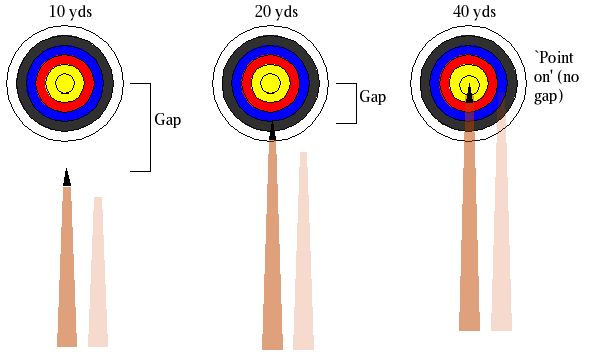
A. Gap shooting is another primitive sighting technique, and is probably used by most traditional archers even if they don't realize it. It works by the archer learning, over many shots, how far the arrow point appears to be below the aiming mark. For example, I know from repeated practice that at 20 yards I have to line up the arrow point with an imaginary point about 8 inches below the aiming mark. At ten yards the `gap' is about two feet. At sixty yards, the arrow point appears about three feet above the mark.
As discussed above, whether there is a form of `instinctive' archery that is different from `gap shooting' is a highly contentious point.
Q. What is 'string follow'?
A. All wooden bows `follow the string'; that is, when they are held at full draw the limbs gradually deflect towards the string. Over time, this effect becomes permanent, and the bow takes on a particular `set'. This does not mean that the bow is unusable, it just means that you won't get the same draw weight that you used to have.
Q. What is stacking?
A. Stacking is the sudden increase in draw weight in the last few inches of draw. All longbows stack to a certain extent -- it is just a feature of the bow shape. However, longbow enthusiasts typically use the term to describe a bow that exhibits the problem more than it should; that is, a bow `stacks' if the draw becomes suddenly and unpleasantly difficult beyond a certain length.
Q. How accurate is a traditional bow?
A. Naturally, this depends on the skill of the archer, and it is important to bear in mind that a traditional longbow was never intended to be a precision weapon. The purpose of a longbow in warfare was to rain down a storm of arrows on the enemy, rather than to hit a particular spot. My experience is that a person who puts in the same amount of practice with a traditional bow and a modern recurve will achieve target scores about half as good with a traditional bow. That is, if at a particular distance your arrows are mostly within the gold ring of a 60cm target face with a recurve, you'll get most of them within the white with a longbow (by the law of averages, some of these arrows are going to be in the black, blue, red, and gold, so your average score will be higher than the `2' you'd score for a white). If, on the other hand, at a particular distance with a recurve your arrows are hitting the blue and red areas, then with a longbow some of your arrows are going to miss the scoring area completely.
Of course, a person who practices extensively with a longbow will be able to achieve scores as high as a person who practices only sporadically with a recurve; but, all other things being equal, modern bows are far more accurate. The use of wooden arrows complicates matters as well (see below).
For the record, on my best days I can get about 50% of my arrows within an 8-inch circle at 20 yards. This is the distance that I shoot best, because it's what I practice in my back garden. If I can shoot even this well I am satisfied, because I genuinely don't think the bow (or rather the arrow) is capable of better accuracy than this, even in the hands of an expert, which I am not. On bad days, I can regularly miss the target boss completely at that distance -- and I have a fair number of bad days. I can only achieve even this rather modest performance when I am practising nearly every day. My observations of people in my archery club who shoot longbow only once a week for an hour or so, suggest that group sizes of 20-30 inches are usual; and these are people who are hitting the gold nine times out of ten at this distance with a recurve. In short, it is not easy to achieve good accuracy with a longbow, and it needs constant practice to maintain even the modest level of accuracy that is achievable.
Q. Why are longbows less accurate than modern bows?
A. Most obviously, you have no sights, no predictable way to compensate for range changes, and you have a much greater amount of `archer's paradox' to contend with. But that's not all. The `cast' of an all-wood bow, particularly a longbow, changes with temperature and humidity. During a two-hour shoot, the draw weight can easily vary by five pounds, which might mean an error of more than a foot at the target. This means that you will have to adjust the position of your imaginary sights continually during a shoot. With a longbow you don't really have time to aim, even with the imaginary sights, because even if you have shoulders like a gorilla and can hold the bow at full draw for more than a second, it's not advisable because the bow will follow the string. With my bow, I find that every extra second I remain at full draw means the arrow falls several inches below the mark at 20 yards.
In reality, for a very skilled archer the limiting factor on accuracy will probably not be the bow at all, but the arrows. It is extremely difficult to obtain, or make, well-matched wooden arrows. To get good consistency from shot to shot you need arrows that are not only matched in weight, but matched in spine as well. Weight-matching is straightforward enough -- if you have enough shafts to choose from, you'll be able to group them by weight. But, having grouped by weight, you'll probably find a 5-10 lb spine variation from arrow to arrow. If you group by spine, you'll probably find a significant weight difference.
In addition to arrow-to-arrow variation, there are factors that affect the flight of wooden arrows as a goup, that have no impact on aluminium or carbon ones, and make it harder to get good absolute accuracy, even when grouping is acceptable. For example, in humid conditions wooden arrows absorb moisture from the air, at a rate which depends on temperature (particularly if they land on the ground!) Shaft spine also varies a little with temperature. Wooden arrows are heavier than aluminium ones of the same spine, so their trajectory is less flat, and greater compensation has to be made for range. Feathers absorb moisture and make the arrow nock-heavy, and so on.
In short, you'll have to accept that, with wooden arrows, no amount of practice will allow you to achieve the same arrow grouping or absolute accuracy as is possible with aluminium or carbon arrows. This is not necessarily a bad thing -- it's good that sometimes the limiting factor is the equipment, and not the operator.
Q. How can I make a traditional bow?
A. I am reluctant to advise on this, because my own bow-making experiments have not been an unqualified success. However, you have three fundamental alternatives: make a laminated bow from a kit; make a laminated or self-backed bow from planed staves, or make a self-backed bow from a tree trunk (or stout branch). In all cases, the time-consuming part of the construction is the gradual process of shaving off wood to give an even curvature when the bow is drawn, with the correct draw weight. Most people use a knife or shave for this, although some favour a hatchet, at least for the initial stages.
Q. What is involved in making a bow from a kit?
A. Most of the cost of a bow is labour, so substantial savings are to be had by buying a kit of parts and building it yourself. The kit will usually consist of two or three staves of wood of about the right length (depending on whether you want a two-ply or three-ply bow), together with material for the handle, nocks, arrow plate, and string. You could use such a kit to make a longbow or, perhaps, a flatbow, depending on how you carved the stave. Typically you'll have to glue the staves and let them set, then carve the bow to shape, testing the draw and curvature periodically to ensure proper weight and tiller. The reports I have had suggest that kit bows rarely snap in half on first draw, and some even shoot quite well.
Q. What is involved in making a bow from staves?
A. You can make a bow from staves of wood, and buy the sundries (horn, leather, etc) relatively cheaply. In principle, you could construct a decent bow this way for about £50. Some care is required to ensure that the grain of the staves runs in compatible directions if you're building a laminated bow -- something that will have been taken care of if you buy a kit. The only practicable way to do this, unless you buy the wood from a bowyer, is to visit the timber yard and pick out the staves yourself. In addition, you'll have to figure out the measurements yourself, making it more likely that the bow will fail when drawn.
Other than these considerations, making a bow from planed staves of wood purchased from a timber yard is not very different to making one from a kit.
Q. What is involved in making a bow from a tree trunk?
If you take a tree trunk, saw it lengths, and plane it, then the process is essentially the same as making a bow from staves of wood. Rather, if you have a trunk, I assume you want to make a self-backed bow with it (it's unlikely that you'll be able to make an unbacked bow of a single type of wood). Not all woods are suitable for making self-backed bows; of the trees that grow widely in the UK, most likely yew and laburnum are most suitable. Ash is easy to work and inexpensive, but not as robust. I once tried to make a bow from oak but, by the time it had dried, carving it was like shaping stone, and I gave up. Nevertheless, other people have reported success. Very few authorities suggest making bows from softwoods (that is, the woods of coniferous trees), because the sapwood splinters more readily under tension. Nevertheless, softwood bows have succesfully been made -- the trick seems to be to make a thin, flat limb shape, to reduce tension forces in the back.
The crucial point to note about making a bow from a tree is that the sapwood of the tree (the outer, growing, layer) is relatively strong in tension, while the heartwood (the dense, inner part) is relatively strong in compression. So you must cut or split your tree trunk in such a way as to capture a part of the sap wood and a part of the heartwood. The sapwood will form the back of the bow (which is in tension), and the heartwood the belly (which is in compression). It follows that, however thick the trunk, only the outermost two inches of thickness will be of any use for bowmaking. However, if you have any choice in the matter, you need a trunk more than four inches thick, because you want to start with billet of wood that is approximately square in cross section.
If you take a four-inch trunk or log, and split it lengthways into four pieces, it will be difficult to make a bow whose shape is anything other than a wedge, which will be uncomfortable to shoot. If possible, you need to start with a trunk at least ten inches in diameter, and split it into however many pieces as will make each piece about two inches across at the widest point (that is, across the sapwood layer). In practice, you're going to end up with a half-dozen potential bowstaves, and a lot of firewood. Of the half-dozen potentials, if you're lucky you'll get one or two that are worth using. If you can't get trunks with a sufficient length of uniform grain, you might have to consider making the bow in two halves, joined at the centre with a steel tube or another piece of wood.
Received wisdom is that cut staves should be seasoned (dried slowly in air) before carving. Be aware that some woods become almost unworkable when fully seasoned, and I have seen good results achieved with freshly-felled wood.
Once you've cut the staves, you'll want to avoid cutting into the back (sapwood) part of the stave at all, except as far as is necessary to strip the bark. Uninterrupted wood fibres are very strong in tension, particularly in the sapwood, but the slightest cut will weaken the wood considerably. Therefore, all the shaping of the bow should be done on the belly (heartwood) side, as far as practicable. Because this part of the bow will be in compression when it is drawn, severing the wood fibres is less catastophic.
It is not easy to obtain wood of sufficient quality to make a self-backed bow, and even in the most expert hands these bows frequently fail the first time they are drawn, usually along the back somewhere.
Q. Should I buy a longbow from an on-line auction?
A. It depends on how much money you can afford to gamble. If it's a bargain it might be worth the risk, but there's a good chance you'll be buying a duff one. Make sure you see a photo of the bow unstrung, as when it is strung you won't be able to assess how much it `follows the string' (that is, whether the limbs have set into a curve by long use). Small amounts of follow (a couple of inches deflection at the tips) are probably no bad thing, but if the deflections are very different between the tips, this could be a sign of incorrect tiller (a manufacturing defect), which is worrisome. It would probably be a bad idea to buy a bow (any bow) that shows signs of delamination (that is, splitting between the laminations), or has any damage to the back. A bow that has been extensively used, but well maintained, is likely to be a better bet than one that has been little used but mistreated. There really isn't any way to determine how well a bow has been treated from a photograph. If the seller can't tell you what wood(s) the bow is made from, or even how many laminations it has, you're likely to be wasting your money.
Whatever the condition of the bow, there's no point one buying one with a maximum draw length which is too short for you, as it will break.
Q. Where can I practice traditional archery?
A. In my experience, most archery clubs welcome traditional archers, but specialist traditional archery clubs are rare. Where they do exist, they tend to be rather obsessive, in my limited experience (What? You don't cut your own feathers?...). Traditional archery tends to be addictive, and you might find it surprisingly easy to form a traditional section in your local archery club. There are benefits to welcoming traditional archers into a predominantly modern archery club, not least because traditional bows are quick to shoot, and cause less congestion on the shooting line than modern ones.
Of course, if you join a modern archery club, you'll have to fit in with the modern way of training, which is to shoot relatively short distances (usually 50 metres or shorter), in a single direction. If you want to practice traditional longbow archery in the traditional way, you'll need to find a club that specializes in this, or is very accomodating. In medieval times, longbow training was invariably two-way, that is, archers shot up the field and then down again. There are safety problems with this kind of practice, particulary if you want to shoot over a hunred yards. You'll need, as a minimum, a very long field. The British Longbow Society promotes the practice of long-distance, two-way shooting, and might be able to help you find a club that does this.
If you want to practice kyudo you'll probably need to join a specialist club, because the pace and ethos of this type of archery doesn't fit all that well with modern archery training.
Q. Are there traditional archery competitions?
There are relatively few competitions specifically for traditional archery; however, most club and county archery events will have a separate longbow class in any competition, so long as there are enough competitors for it to be worthwhile. People shooting traditional bows other than longbow might have a problem, because there usually won't be enough to form a separate class. So if you shoot, say, a Hungarian bow, you'll probably have to join the general `barebow' class, and compete against people shooting Olympic recurves and carbon arrows, merely without the benefit of sights. Your prospects of a medal will not be good.
Published 2007-08-03, updated 2026-02-23
Categories
archery shooting sportsConverted from my Gemini capsule.